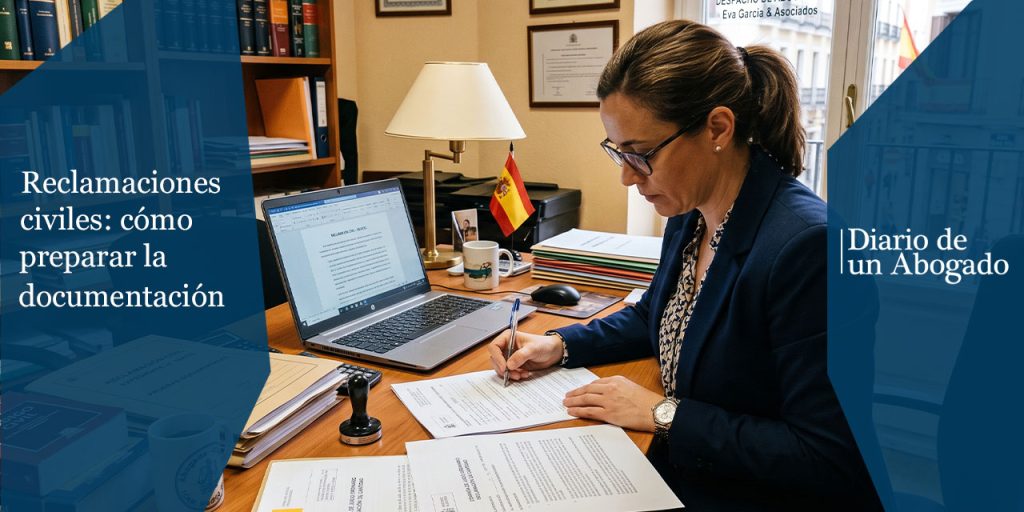
When you face a dispute and need to bring a civil claim, the difference between winning and losing usually lies in how the documentary evidence was prepared. In civil law the judge does not decide on intuition, but on the documents put before them.
If you are thinking of taking legal action, at Diario de un Abogado we set out step by step how to prepare the material your claim will rest on.
1. Why documentary evidence is decisive
In civil proceedings the burden of proof falls on the claimant. Explaining what happened is not enough; it has to be established. Bringing a civil claim without the right documents is often a battle lost before it starts.
The documents serve to:
-
Show that a contractual or factual relationship existed.
-
Quantify the financial loss suffered.
-
Establish that you tried to resolve the dispute amicably (the formal demand).
2. The essential documents
Whatever the subject matter — arrears, breach of contract, property damage — some documents are indispensable:
A. The contract or founding document
This is the backbone of the claim. It may be a lease, an engagement letter, a sale contract or even accepted quotations. Where there is no written contract, emails or WhatsApp messages evidencing the agreement will do.
B. The formal demand
Before going to court it is essential to have sent a letter before action. It is the proof that you sought an amicable solution and that the debtor or the other party is in default or has broken their obligations.
C. Evidence of loss (invoices and expert reports)
If you are claiming a sum of money, you have to justify it with tangible documents:
-
Repair invoices.
-
Third-party quotations.
-
Expert reports valuing the damage.
-
Bank statements evidencing payments made.
3. The chain of communications
Today a great many civil claims rest on digital communications. Keep them and organise them:
-
Emails: they should be clear and show the sequence of the negotiation.
-
Text messages: make sure the screenshots are legible.
-
Certified delivery: where the communication is formal, we recommend sending it by burofax, the Spanish certified-content service, so that it carries evidential weight before a judge.
4. How to organise the file
To make the process faster and cheaper, hand the documents to your lawyer in this order:
-
A chronology: a short summary of what happened, date by date.
-
An index: number every document.
- A digital folder: send everything as PDFs, not blurred photographs or scattered files.
5. What if a document is missing?
Clients very often arrive worried because they have no signed contract on paper. Do not give up on the claim: Spanish civil law follows the principle of freedom of form, which means verbal agreements are also valid.
Where an official document is missing, the case can be built on other evidence:
- Witnesses: statements from people present at the agreement or the damage.
- Bank records: a payment or transfer can by itself show that an agreement existed.
- Court orders for disclosure: in certain civil claims your lawyer can ask the judge to order the other party, or an outside body such as a bank or a registry, to produce the documents you do not have.
Conclusion: preparation is the strategy
A well-documented civil claim has far better prospects. Do not wait for the dispute to escalate before you start gathering evidence.
Request legal advice in Barcelona
Need help preparing your claim? At our office at Calle Balmes 188 we will help you build the strategy.
-
Phone: +34 611 647 462
-
Email: info@diariodeunabogado.es