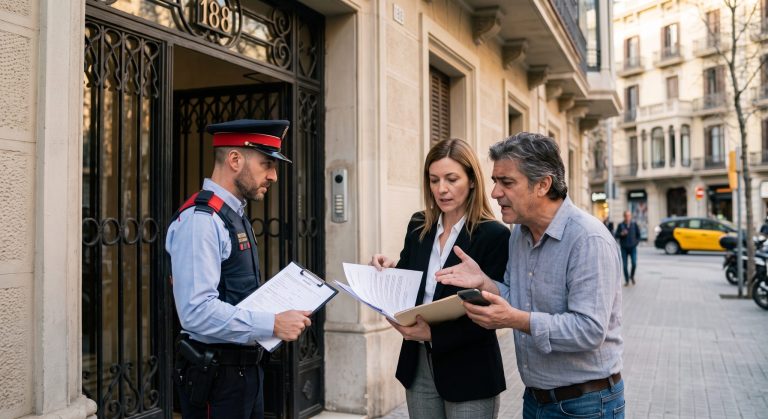

If you have been summoned to appear as an investigado — a person under investigation in Spanish criminal proceedings — what you do in the first 48 hours matters more than you might think. This guide deals with Spanish law and with proceedings before the Spanish courts; if your case is being heard in another country, the rules described here will not apply to you. Not because the case is resolved in two days — it is not — but because decisions that are hard to undo get made in that window: whether you give a statement, what documents you keep, who you call and who goes to court with you.
Do you have the summons in front of you and a hearing this week? Call us on 611 647 462 or tell us about your case. We will go through the summons with you before you attend.
What being “under investigation” actually means in Spain
Being an investigado means a Spanish investigating court has opened proceedings and considers there is some indication linking you to events that could amount to a criminal offence. Nothing more. It does not mean you have been formally charged, and still less that you have been convicted.
Until 2015 this procedural status was called imputado. The term was changed precisely because in everyday Spanish it had come to sound like a finding of guilt, which it never was in law. The change of name did not alter the rights attached to the status: they are the same, and they are extensive.
Under investigation is not guilty, and that is not a technicality
Many Spanish proceedings are closed during the investigation stage without ever reaching trial. Others end in sobreseimiento — a formal dismissal — when the judge concludes the facts are not criminal or that there is not enough evidence. Being summoned does not prejudge the outcome: it defines the stage you are at and the rights you can exercise from now on.
First of all: read the summons carefully
It sounds obvious and almost nobody does it. The summons contains the information that shapes the whole strategy, and there are four things worth identifying before you do anything else.
- In what capacity you are summoned. Attending as an investigado, as a witness or as an injured party are very different things. If the document says investigado, you have the right to a lawyer and the right to remain silent. If it says testigo (witness), the duty to tell the truth is different and so are the consequences of not attending.
- Which court has summoned you. An investigating court, a court for violence against women, a criminal court or the judicial police itself are not at the same stage of the process.
- For what facts. Sometimes the alleged offence is named and sometimes only a case number appears. If it is not stated, your lawyer can apply for access to the case file before the hearing.
- The exact date, time and place. Along with the time you actually have left, which determines whether an adjournment can still be requested.
The first 48 hours: five decisions that shape the case
1. Do not contact the person who reported you
This is the most common and the most expensive mistake. The intention is usually good — to clear up a misunderstanding, to ask them to withdraw the complaint — but the result can be a second set of proceedings for coercion or threats or, if a restraining order is already in force, for breaching it. In relationship breakdowns this is particularly delicate, because the conversation you experience as an attempt to fix things can be documented as pressure. If you have children together and need to communicate about contact arrangements, let that go through your lawyer or the agreed channels.
2. Do not delete anything
Not messages, emails, photos or call history. Two reasons. First, deleting material that might exonerate you leaves you without evidence exactly when you need it. Second, the other person’s devices keep copies, and selective deletion shows: a gap in a conversation draws more attention than the whole conversation would have.
3. Gather your documents while your memory is fresh
Write a chronology of events with specific dates, while you still remember them clearly. Collect contracts, transfers, medical reports, receipts, location data, emails. Note down who could give evidence about what happened and how to reach them. This is the work that turns an account into a defence, and nobody can do it better than you.
4. Decide with your lawyer whether to give a statement
You have the right not to give a statement, not to incriminate yourself and not to plead guilty. This is not a trick or a sign of guilt: it is a constitutional right under Spanish law, and no adverse inference may be drawn from exercising it — which is an important difference from some other legal systems.
Whether giving a statement is advisable depends on what your lawyer has been able to see in the file. Making a statement without knowing its contents is like answering an exam paper without reading the questions. Sometimes the best strategy is to give a statement and submit documents at the same hearing; sometimes it is to remain silent and set out the defence once the full material is known. That decision is a technical one and is taken case by case.
5. Confirm who will represent you
Do not leave this call until the night before. A lawyer needs time to request access to the file, study it and prepare the hearing with you. Arriving at court without that groundwork is the situation worth avoiding.
We can review your summons this week. Write to us from the contact page and ask for our first 48 hours checklist: we will email it to you, with the documents worth gathering for each type of proceedings.
Can I simply not attend?
Two things are often confused here. You have the right to remain silent, but not the right to stay away. A Spanish court summons is an obligation: if you do not attend and do not justify your absence, the court can order you to be brought in by the police and, in certain cases, consider precautionary measures. It makes your position worse for no reason.
If the date is genuinely impossible for reasons you can evidence — a hospital admission, a trip already booked and documented — the correct route is to apply in writing and in advance for an adjournment, attaching the supporting document. Simply not turning up and explaining afterwards is not enough.
Duty solicitor or a lawyer of your choosing
If you do not appoint a lawyer, one will be assigned to you from the duty rota (turno de oficio). Duty lawyers are fully qualified members of the Bar and perform an essential role in urgent assistance. The difference is time: a duty lawyer usually learns about the case shortly before the hearing, whereas a lawyer you appoint can study the file days in advance and prepare the hearing with you.
If your income is below the statutory thresholds, you can apply for free legal aid (asistencia jurídica gratuita). It is worth checking before ruling the option out on cost grounds — this is available to foreign nationals resident in Spain as well.
What happens after the hearing
The hearing settles nothing on its own. From there, the court may order further steps — witnesses, expert reports — close the case if it finds no offence or insufficient evidence, or move towards trial. Months can pass between a statement as an investigado and any eventual trial, and in that time the defence keeps working: proposing evidence, challenging the prosecution’s and, where appropriate, negotiating.
If the facts are minor, the case may follow the route of the minor offence procedure, which has its own rules and time limits and a different effect on your criminal record.
The mistakes that cost the most
- Putting your explanation in writing before speaking to a lawyer. A message sent to clear things up ends up in the file exactly as written, without context.
- Telling your account to the wrong person. What you tell a third party can end up being given in evidence. What you tell your lawyer is covered by professional privilege.
- Treating a minor offence summons as trivial. “It is nothing” is the sentence that precedes a great many avoidable convictions.
- Going alone to show you have nothing to hide. The court does not read it that way; it simply leaves you without legal assistance.
- Handling the criminal and family cases separately. When a complaint arises in the middle of a relationship breakdown, the two tracks affect each other. We cover this in our guide to cross-allegations in a divorce.
Frequently asked questions
Will I be arrested if I attend?
A summons to give a statement as an investigado is not an arrest warrant. Normally you attend, either give a statement or exercise your right to silence, and leave. Precautionary measures are ordered in specific, reasoned circumstances, not because you turned up.
Can I bring my own lawyer on the day?
Yes, and it is advisable. You can also notify the court of the appointment in advance, which makes it easier for your lawyer to obtain access to the file beforehand.
Will this give me a criminal record in Spain?
Being under investigation does not create a record. A Spanish criminal record arises from a final conviction, and can be cancelled once the statutory periods have passed, depending on the severity of the sentence.
What if the complaint is false?
If it is established that the complaint was made knowingly against the truth, there may be liability for false accusation. But that is a route raised once the main proceedings have concluded and with the evidence in hand, not as an immediate reaction.
How long does all this take?
It depends on the complexity and on the court’s workload. A straightforward investigation may be resolved in months; a case with several expert reports, considerably longer. Your lawyer can give you a realistic horizon once they have seen the file.
Speak to a criminal defence lawyer in Barcelona
The firm handles criminal defence at every stage of Spanish proceedings, from assistance in police custody through to trial, as well as family law, which is where the two fronts most often meet. If you want to know when it makes sense to act, our guide on when to call a criminal lawyer in Barcelona may help.
Tell us about your case and we will go through the summons with you. Call 611 647 462, write to us from the contact page or come to the office at Calle Balmes 188, Barcelona. We also advise online throughout Spain, and we work in English.
This article is for general information and refers to Spanish law. It does not constitute legal advice and does not replace the assessment of a specific case: every set of proceedings has its own circumstances and requires an individual assessment by a qualified professional. Manuela Muñoz, admitted to the Barcelona Bar (ICAB 37992).