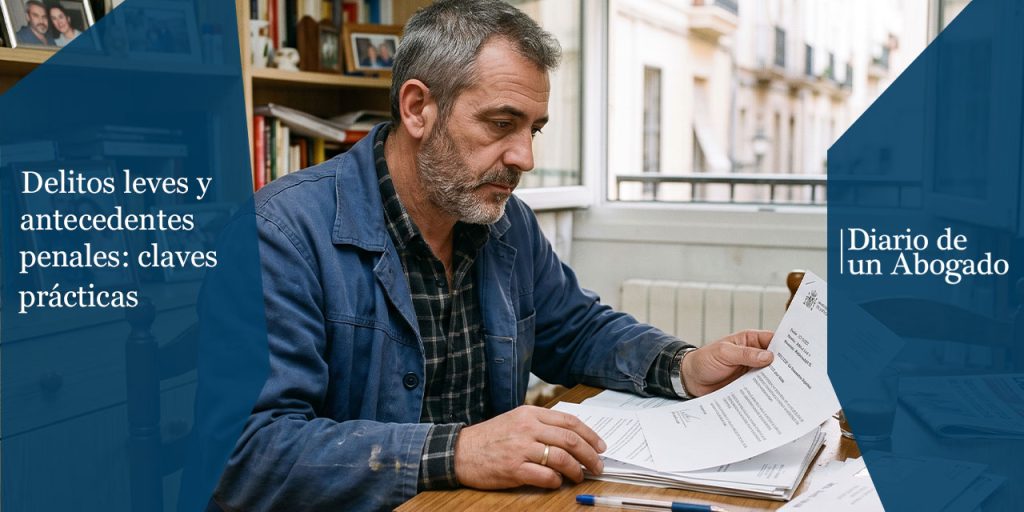
A court summons over a minor incident causes a great deal of anxiety, mostly out of fear that one small mistake will stain your record. When it comes to minor offences and a criminal record there is widespread confusion, because many people still believe small infractions leave no trace.
At Diario de un Abogado we want to set out what actually happens after a minor conviction, and what you can do to protect your future.
1. How minor offences and a criminal record are connected
The commonest mistake is to think of the old category of «faltas». Before the 2015 reform of the Criminal Code, those minor infraction hearings created no record. That category no longer exists.
Today those infractions have become minor offences — theft under 400 euros, minor assault, low-level threats. The single most important practical point is this: today any final conviction for a minor offence does create a criminal record. It makes no difference that the sentence is only a small fine; the entry at the Ministry of Justice is automatic.
2. What a criminal record for a minor offence actually affects
Many people go to the hearing treating it as trivial, assuming a small fine is the whole of the punishment. A record for this kind of offence can affect you at key moments:
-
Employment: many employers, particularly in security, education and the public sector, require a clean criminal record certificate to hire you or to let you sit a public sector competition.
-
Immigration: if you are a foreign national, a criminal record for a minor offence can mean automatic refusal when applying for or renewing a residence permit, or when applying for Spanish nationality.
3. Why you should not attend the hearing alone
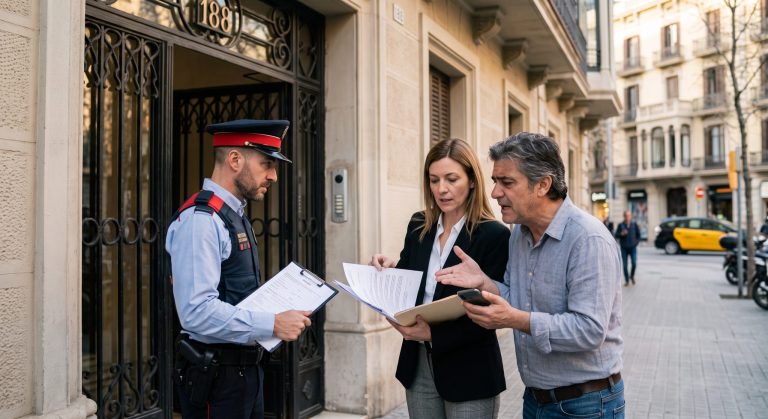
In most minor offence hearings the law allows the accused to attend without a lawyer. It is a trap a great many people fall into.
Attending without professional representation means facing a judge, and often a prosecutor, without knowing the rules of the procedure or how to cross-examine witnesses or put forward admissible evidence. Attending with a criminal defence lawyer is the best strategy for an acquittal — and for preventing the conviction from ever happening.
4. How long the record lasts
If you have already been convicted, the good news is that the entry does not last forever. The Criminal Code sets specific periods after which the record can be cleared.
For minor offences, that period is six months. It starts to run from the day you finish serving the sentence — for instance, the day you pay the last instalment of the fine — provided you do not reoffend during it.
5. Is the record cleared automatically?
Another essential point: clearing the record is rarely done of the court’s own motion. Once the six months have passed, you should file a formal application with the Ministry of Justice. If you do not, the record may keep appearing on the databases for months, which can cost you at exactly the wrong moment.
Conclusion: do not leave your future to chance
Any criminal procedure, however small it looks, calls for strategy and rigour. Minor offences and a criminal record are closely tied, and the consequences can surface years later. Do not simply pay the fine to «get it over with» without first assessing your options.
Expert criminal defence in Barcelona
Have you been summoned to a minor offence hearing, or do you need your record cleared? At our office at Calle Balmes 188, Manuela Muñoz will review your case in complete confidence to protect your record.
-
Phone: +34 611 647 462
-
Email: info@diariodeunabogado.es